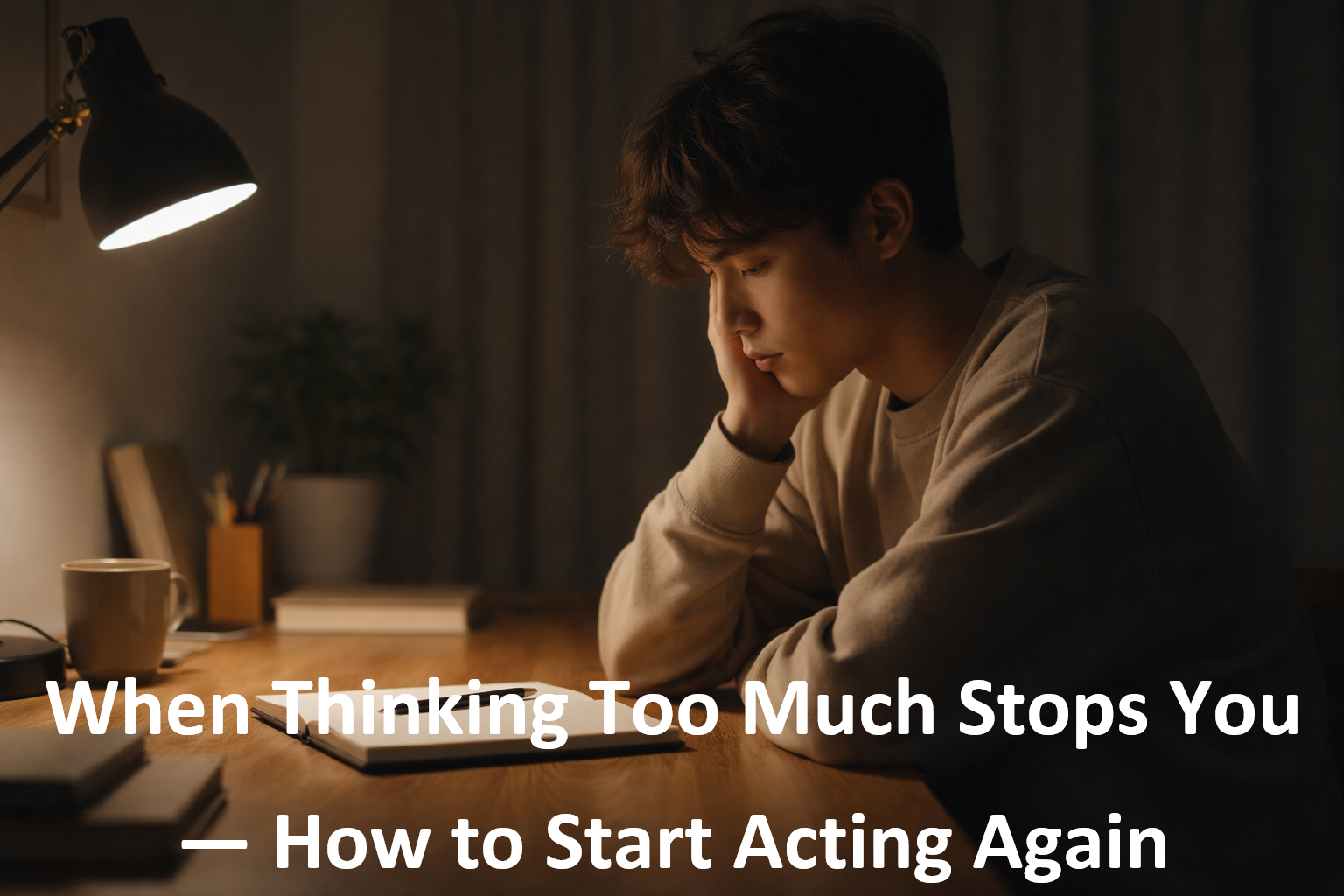
Overthinking After Failure — Why You Freeze and How to Move Again
After a setback, your mind can get loud. You replay what happened, imagine every risk, and keep trying to find a “perfect” answer.
But even when you feel like you’re thinking hard, nothing changes in real life. That is not caution. It’s paralysis.
What “Overthinking Paralysis” Feels Like
You know what you should do, but your body won’t move.
You keep refining the plan, rewriting the scenario, and waiting for certainty — until time passes and your confidence drops.

Why Overthinking Stops Action
After a failure, the brain shifts into protection mode. The goal changes from moving forward to avoiding pain.
To prevent another mistake, it tries to simulate every possible outcome. But the more possibilities it creates, the harder it becomes to choose one.
Eventually, thinking replaces action. You feel busy in your head, but nothing changes in reality. This is not “being careful” — it’s getting stuck.

What to Do Instead
- Reduce the decision to one tiny step. Ask: “What is the smallest action I can take today?”
- Set a time limit for thinking. Example: 20 minutes to plan, then start.
- Separate facts from fear. Write down what you know vs what you assume.
- Choose progress over proof. You don’t need certainty — you need feedback from reality.
- Return to basics. Sleep, food, hydration, and a short walk can reset your nervous system.
A Simple Reset Checklist
- One sentence: “What happened?” (facts only)
- One sentence: “What did I learn?”
- One action: “What will I do next?” (10 minutes max)
The experience behind this perspective
Episode 09: Trapped in My Winning Pattern
This article is based on real past experiences and is written to support learning and safe decision-making. It does not glorify dangerous behavior.
This article is part of Second Gear Life, a site that organizes life experiences into practical understanding.
→ Back to main page



コメント