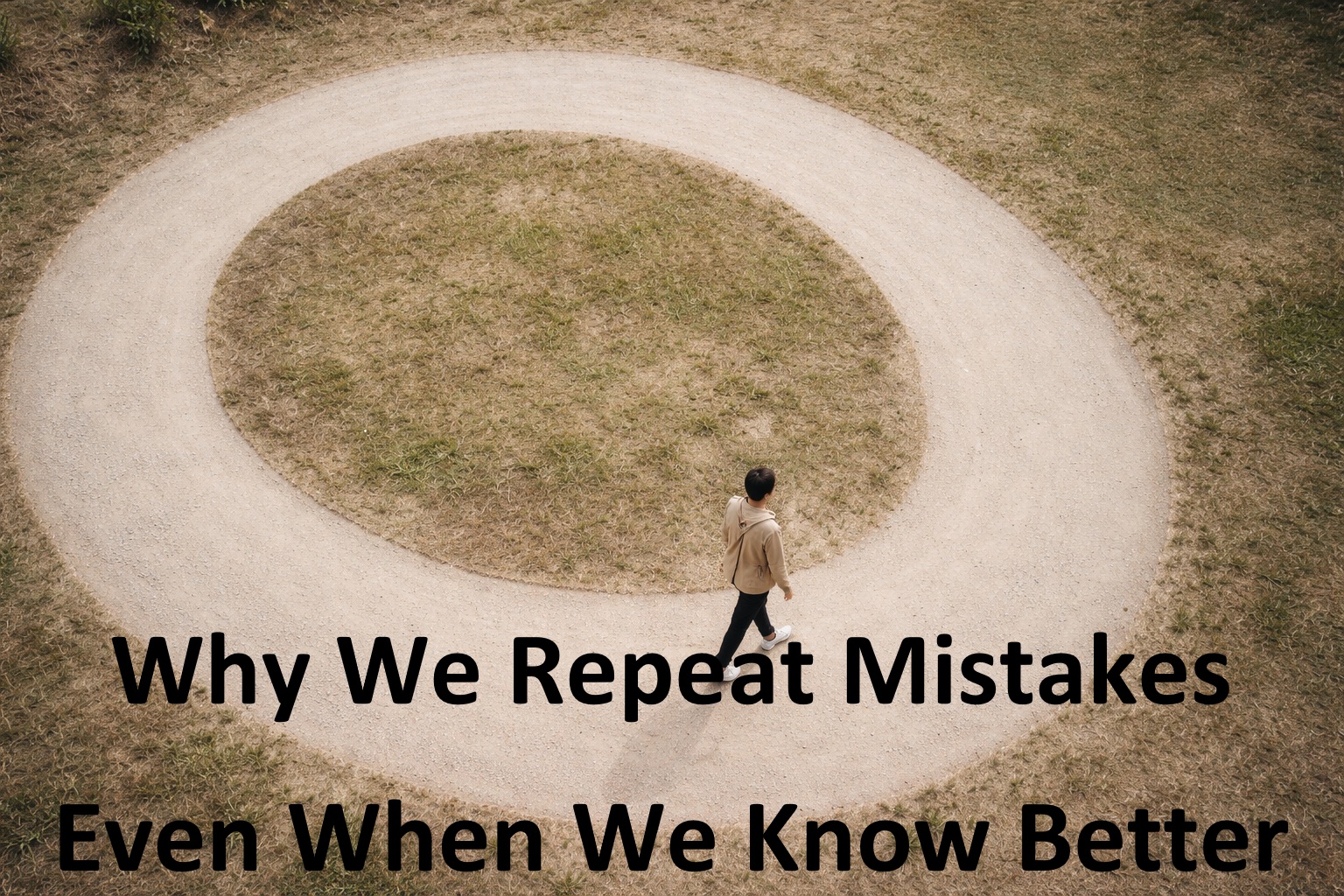
Why We Repeat Mistakes Even When We Know Better
This article explains why understanding is not enough to change behavior, and provides a practical framework to reduce repeated mistakes by changing decision conditions.
I knew better. Still, I made the same decision again. Looking back, the mistake was avoidable. But in the moment, it felt different — as if the usual rules didn’t apply. This isn’t written to blame anyone. It’s written to make the structure visible.
Experience: Knowing better, repeating anyway
(Insert your specific experience here. Keep it concrete: situation, choice, outcome, and emotion.)
- Situation: what happened, where, and when
- Choice: what you decided to do
- Outcome: what happened next (loss, regret, conflict, etc.)
- Emotion: urgency, anxiety, irritation, fear, etc.
The key insight is this: it wasn’t a lack of knowledge. It was a setup where the same conditions triggered the same reaction.
Why Understanding Alone Doesn’t Stop Us
There is a gap between knowing and choosing. Knowledge lives in logic, but many decisions are driven by emotion and habit.
When emotion becomes strong, the brain prioritizes immediate relief over long-term accuracy. The question shifts from “Is this right?” to “Does this feel better now?” That is why choices repeat even when we understand the consequences.
- Short-term relief wins: delay, instant decisions, defensive replies
- Selective attention: we search for comfortable evidence and ignore warnings
- Justification: “this time is different” prevents learning from sticking

Habit Is Stronger Than Awareness
Repeated behavior becomes automatic. Once a pattern is formed, it runs without conscious evaluation. If the environment remains the same, the reaction tends to repeat.
This is not weakness. It is automation. If the same trigger appears, the same response appears. That’s why the most effective fix is often not “more knowledge,” but changing the conditions around the decision.
(Insert the footprints image here. Recommended placement: right before the next section.)
The Trap: Knowledge Feels Like Progress
Understanding creates a sense of control. When we can explain the reason, it feels like we have already improved. But being able to describe a pattern is not the same as interrupting it.
Change requires friction — a small delay or a required check that prevents an automatic reaction from becoming the final choice.
Change the Environment, Not Just Your Willpower
“I’ll be careful next time” is rarely enough. If the same situation returns, the same shortcut returns. To reduce repetition, redesign the decision environment.
Three practical changes
- No instant decisions: wait at least 10 minutes for high-stakes choices
- Fixed verification: write down 3 facts before deciding (no interpretation)
- Outside review: ask someone to check your reasoning when emotions are high
The goal is not to become “stronger.” The goal is to design conditions where the same trigger does not produce the same outcome.
Minimal Checklist: Change the Next One
- Name the emotion in one word
- Write 3 facts without evaluation
- Ask: “Can this wait 10 minutes?” If yes, delay
- Ask: “Has this happened 3 times?” If yes, it’s a pattern
- Decide one thing to stop doing next time
You don’t need to change everything at once. If you can change the next one, the loop weakens.
Related articles:
When Thinking Too Much Stops You — How to Start Acting Again
How to Identify Your Losing Patterns


コメント