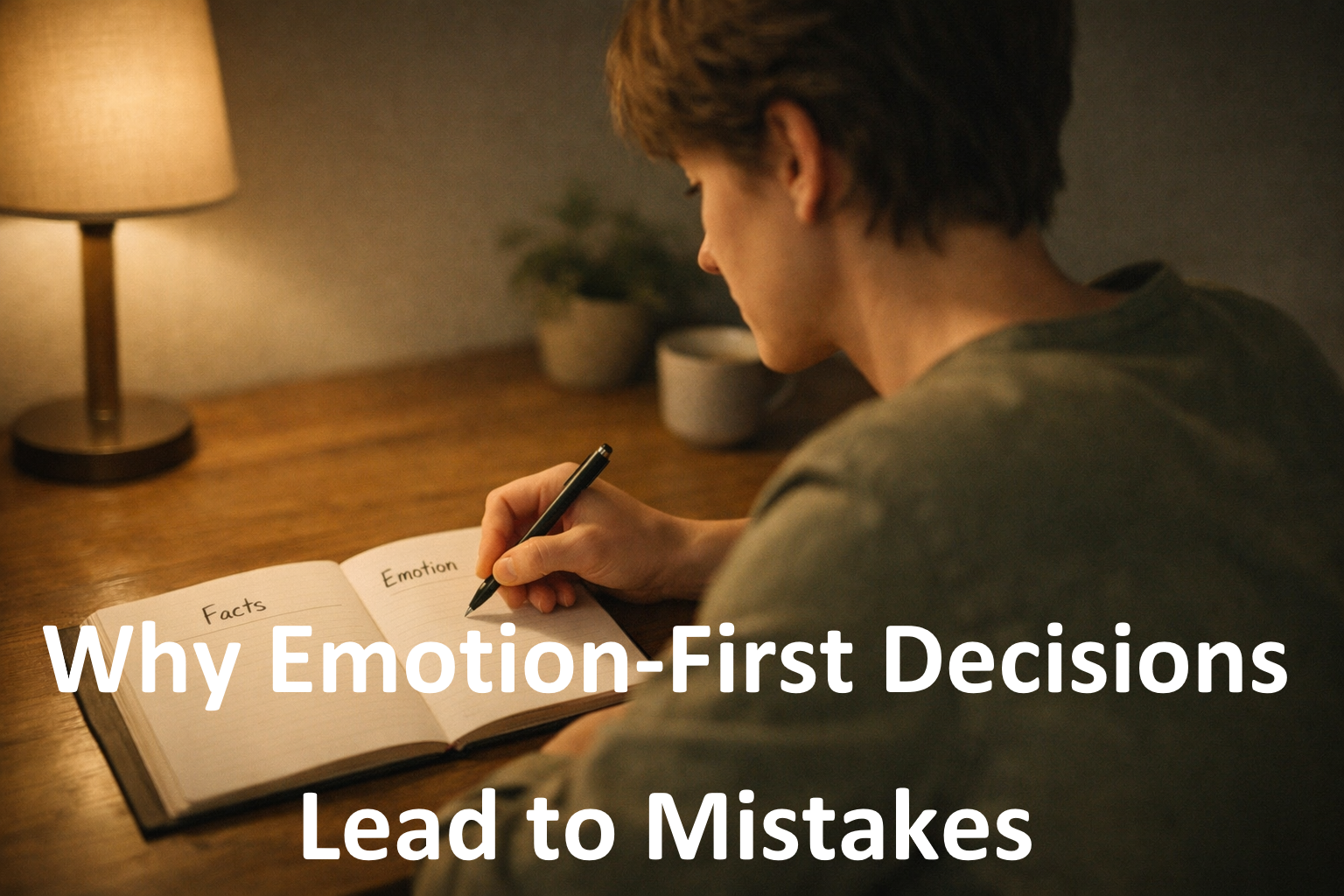
Why Emotion-First Decisions Lead to Mistakes
Looking back, it’s easy to think, “Why did I decide that?”—but in the moment, it feels completely right. This article explains why decisions become distorted when emotions take the lead, and gives a simple reset procedure you can use the next time you’re stuck in that state.
Experience: The moment emotion took the wheel
(Write your real example here. Keep it specific: what happened, what you felt, what you decided, and what the outcome was.)
- What happened (facts):
- What you felt:
- The decision you made:
- What happened next (outcome):
- What you realized later:
The core problem: What changes when emotion leads
When emotions take control, your brain shifts into “protect me now” mode. Decision quality drops. Typically, three things happen:
- Your view narrows: you stop seeing inconvenient information
- Long-term thinking disappears: short-term relief looks like the best option
- Defensiveness increases: you spend energy proving you’re right instead of correcting course
Why it happens: The psychology (keep it simple)
You don’t need heavy theory here—just the mechanism.
- Strong emotion is treated like “danger”: your brain rushes to a conclusion to feel safe
- Short-term reward bias: choices that feel good now look more convincing than they are
- Self-protection: it’s emotionally cheaper to justify than to admit a mistake

Reset procedure: Restore the order in 5 minutes
You don’t need to eliminate emotion. You only need to restore the order. Use this “5-minute rule.”
The 5-minute rule
- Write the facts in one sentence (no evaluation, no interpretation)
- Name the emotion in one word (anger / anxiety / frustration / fear / etc.)
- Decide “not now” (delay the decision for 5–30 minutes)
The key is separating facts from feelings before you choose your next move. This helps you exit “rush to conclusion” mode and regain realistic options.
Summary: Don’t deny emotion—change the sequence
Emotion isn’t the enemy. The problem is the sequence becoming “emotion → decision.” When you restore “facts → emotion → delay,” your next step becomes clearer and more grounded.
Foundation article → Why overthinking stops action


コメント